
1. Executive Summary: The Industrialization of Cold Therapy

The global wellness economy is witnessing a structural transformation as it moves from passive relaxation to active recovery, with the commercial ice bath market emerging as a linchpin of this evolution. Once a niche modality confined to elite athletic training facilities and clinical rehabilitation centers, Cold Water Immersion (CWI) has metastasized into the broader commercial landscape. By 2026, the market will no longer be defined by residential adoption but by the rapid industrialization of cold therapy infrastructure in high-volume commercial settings—spanning big-box gym chains, boutique franchise studios, luxury hospitality, and the burgeoning "social wellness" sector.
The trajectory of the market is aggressive. Valued at approximately USD 330.58 million in 2024, the sector is projected to nearly double, reaching upwards of USD 660 million by the early 2030s, with some forecasts for the broader chiller market exceeding USD 1.12 billion by 2031. This growth is underpinned by a Compound Annual Growth Rate (CAGR) exceeding 8%, though specific sub-segments such as commercial-grade chillers and integrated recovery suites are expected to outperform the aggregate market.Crucially, the commercial sector now commands over 80% of the market share by application, a figure that highlights the capital intensity and infrastructure requirements of the next phase of growth.
This report offers an exhaustive, data-driven analysis of the commercial ice bath ecosystem as it heads toward 2026. It dissects the transition from residential-grade "prosumer" units to industrial 1HP chiller systems capable of 24/7 duty cycles. It analyzes the unit economics of contrast therapy, where franchises like SweatHouz and Restore Hyper Wellness are demonstrating Average Unit Volumes (AUVs) ranging from USD 850,000 to USD 1.2 million, validating the profitability of cold therapy as a standalone business model.Furthermore, it maps the complex regulatory landscape, specifically the looming impact of NSF/ANSI 50 sanitation standards and the phasing out of high-GWP refrigerants by 2026, which will force a hardware refresh cycle across the industry.
The following analysis serves as a strategic roadmap for investors, facility operators, and manufacturers, identifying the high-growth corridors in North America, Europe, and Asia-Pacific, and articulating the technological and operational imperatives required to capture market share in a rapidly maturing industry.
2. Macro-Economic Context and Market Sizing
To understand the commercial ice bath market of 2026, one must first situate it within the broader macro-economic shifts of the post-pandemic wellness economy. The global wellness market, valued at over USD 5.6 trillion, is shifting towards "longevity" and "performance," themes that directly benefit the cold therapy sector.
2.1 Global Market Valuation and Forecasts
The quantitative landscape of the cold plunge market is characterized by robust growth, driven primarily by commercial capital expenditure.
● Total Addressable Market (TAM): The core market for cold plunge tubs was valued at USD 330.58 million to USD 350.3 million in 2024. This valuation includes the tubs and integrated systems but excludes the broader ecosystem of ancillary services.
● The Chiller Sub-Market: A critical and often overlooked component is the specialized chiller market. The global Ice Bath Chiller market alone was valued at USD 685 million in 2024 and is forecast to reach USD 1.12 billion by 2031. This divergence suggests that the value of the mechanical components (refrigeration) often exceeds the value of the vessels themselves, highlighting the importance of thermal engineering in the value chain.
● Growth Rates (CAGR): The market is projected to grow at a CAGR of 7.5% to 8.1% through 2033. However, this aggregate figure masks the explosive growth in specific commercial pockets, such as the Asia-Pacific region, which is expected to register a CAGR of 10.5% in the cryotherapy and cold recovery sector.

2.2 Commercial vs. Residential Dynamics
A pivotal trend for 2026 is the widening gap between the commercial and residential segments. While the residential market drove the initial "Wim Hof" boom during the COVID-19 pandemic, the commercial sector has now assumed the dominant position.
Table 1: Market Segmentation by Application (2024-2030)

Application Segment | Market Share (2024) | Growth Drivers | Key Constraints |
Commercial | 81.3% | Franchise expansion (Restore, SweatHouz), Gym retrofits (Equinox, Crunch), Corporate wellness. | High CaPex ($10k-$30k/unit), Regulatory compliance (NSF 50), Maintenance overhead. |
Residential | ~18-20% | Biohacking influencers, Remote work lifestyle, Home gym expansion. | Space constraints, Noise of chillers, Maintenance fatigue, DIY alternatives. |
The data indicates that while residential unit volume may be high, the revenue volume is overwhelmingly concentrated in the commercial sector due to the higher price point of industrial-grade equipment. Commercial units typically retail between USD 10,000 and USD 30,000, compared to USD 1,000 to USD 5,000 for residential units. This 80/20 split is expected to persist or deepen as regulatory barriers make it harder for non-commercial grade equipment to be installed in public facilities.
2.3 The Displacement of Whole-Body Cryotherapy (WBC)
For the past decade, nitrogen-based Whole-Body Cryotherapy (WBC) dominated the commercial recovery landscape. However, 2026 outlooks suggest a significant displacement of WBC by cold water immersion (CWI). While the cryotherapy market remains large—projected to reach USD 7.1 billion by 2030 —business owners are increasingly pivoting to cold plunges.
The rationale for this shift is driven by Operational Expenditure (OpEx) and Customer Experience (CX):
1. OpEx Efficiency: WBC chambers require liquid nitrogen contracts or high-amperage electrical setups for electric chambers. Nitrogen is a volatile consumable with fluctuating prices. In contrast, a cold plunge chiller runs on standard electricity, costing significantly less to operate daily.
2. Therapeutic Perception: The hydrostatic pressure of water provides a deeper, more intense sensation of cold compared to the "dry cold" of air-based cryotherapy. This aligns with the "do hard things" ethos of the modern wellness consumer.
3. Capital Efficiency: A single electric cryochamber can cost upwards of USD 150,000. For the same capital outlay, a facility can install 5-7 commercial cold plunges, drastically increasing user throughput and revenue potential per square foot.
3. Growth Drivers: The Architecture of Demand
The expansion of the commercial ice bath market is not merely a fad but a response to deep-seated shifts in consumer behavior and the business logic of the fitness industry.
3.1 The "Social Wellness" Phenomenon

Perhaps the most transformative driver is the rise of "Social Wellness" clubs. These venues are designed to replace bars and restaurants as the primary location for socialization, using recovery modalities as the communal activity.
Remedy Place serves as the archetype for this model. Founded by Dr. Jonathan Leary, the club positions itself as a "social self-care" destination. Their business model proves that cold plunging can be a group activity, driving revenue not just from membership but from events. Remedy Place reported a 65% revenue increase in their out-of-club events business, facilitating over 13,000 ice baths off-site for partners like HBO and Coachella.
This trend forces a redesign of commercial equipment. The solitary "tub in a corner" is being replaced by:
● Squad Plunges: Larger vessels designed for 4-6 people to plunge simultaneously.
● Acoustic Engineering: Chillers must be silent to allow for conversation and meditation, necessitating remote-condenser configurations or sound-dampened cabinetry.
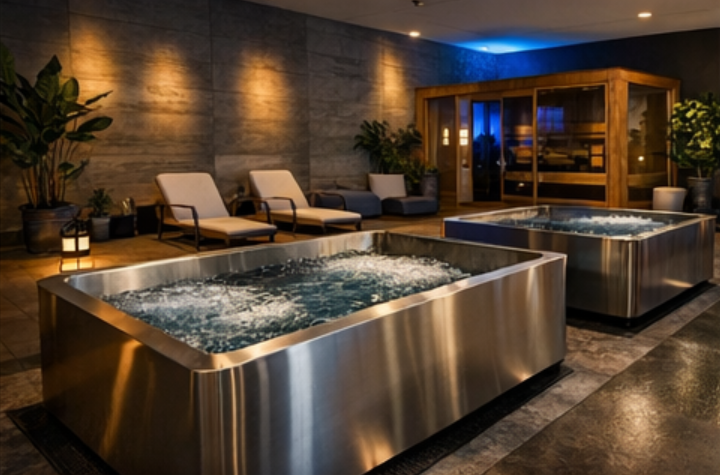
● Aesthetic Integration: The equipment must match the interior design of a luxury lounge, utilizing materials like cedar, stone, and copper rather than industrial plastic.
3.2 The Franchise Scale-Up: Standardizing Recovery
The franchising of contrast therapy has introduced standardization and massive purchasing power to the market. Two key players illustrate this trend:
1. Restore Hyper Wellness: With over 225 locations and growing, Restore has industrialized the delivery of recovery services. Their Franchise Disclosure Document (FDD) reveals an Average Unit Volume (AUV) of USD 851,000, with top-performing studios generating significantly more. This financial success encourages rapid territory expansion, creating a steady stream of orders for commercial cold plunge manufacturers who can meet their strict specifications.
2. SweatHouz: This franchise focuses specifically on the private suite model (Sauna + Cold Plunge + Shower). Their 2024 FDD points to top-performing studios generating over USD 1.2 million annually. SweatHouz plans to have 100 locations operating by 2026. This specific model requires compact, ultra-reliable units that can operate in small, enclosed rooms without overheating—a significant engineering challenge that drives innovation in heat exchange efficiency.
3.3 The "Gym Floor" Retrofit
Traditional big-box gyms are aggressively retrofitting their facilities to include "Recovery Zones" as a retention tool.
● The Retention Metric: Data indicates that facilities offering recovery experiences see an 18% increase in membership renewals and a 22% rise in client satisfaction scores.
● Major Adopters: Chains like Crunch Fitness, EōS Fitness, 24 Hour Fitness, and Equinox have begun rolling out cold plunges in select locations.
● The "Amenities War": As the market saturates, a cold plunge becomes a table-stakes amenity, similar to how saunas were in the 1990s. This volume-based demand favors manufacturers who can offer "Fleet Management" software to monitor hundreds of tubs remotely.
3.4 The Longevity and Corporate Wellness Demographic
Beyond athletes, the "Longevity" movement—popularized by figures like Dr. Andrew Huberman and Peter Attia—has brought cold therapy to the corporate executive and aging demographic.
● Corporate Adoption: High-end office developments and corporate HQs are installing wellness suites to lure workers back to the office.
● Medical Wellness in Europe: In the DACH region (Germany, Austria, Switzerland), cold therapy is integrating into the established Kur (cure) system. The market here is driven by older, affluent consumers seeking evidence-based interventions for inflammation and metabolic health. This demographic demands precise temperature control and hygiene, pushing the market toward medical-grade device certification.
4. Technical Architecture: Defining "Commercial Grade"
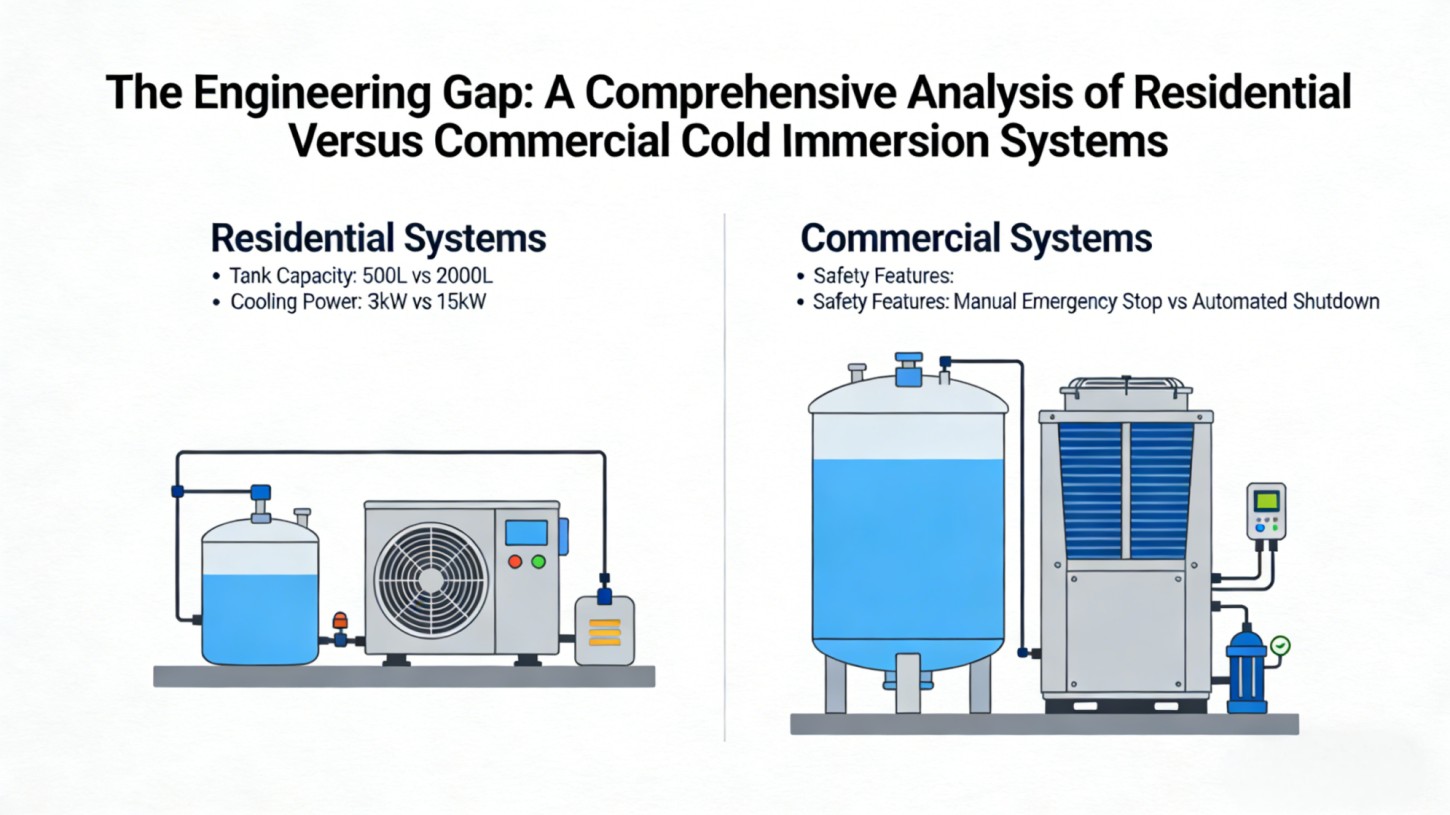
By 2026, the term "commercial grade" will no longer be a marketing buzzword but a codified set of technical specifications. The days of using modified aquarium chillers (1/3 HP or 1/2 HP) in commercial settings are ending due to performance failures and regulatory pressure.
4.1 The Chiller: The Heart of the System
The commercial standard for 2026 is firmly centered on 1HP (Horsepower) chillers or greater. The physics of high-throughput usage dictates this requirement.
● Thermal Load Management: A human body is a 98.6°F (37°C) heat source. When a user enters a cold plunge, they transfer a significant amount of heat into the water. In a commercial setting with back-to-back users (e.g., 6 users per hour), a 1/2 HP chiller cannot remove this heat fast enough, causing the water temperature to creep up, ruining the therapeutic effect for subsequent users.
● Cooling Capacity: A 1HP chiller typically provides roughly 9,000-12,000 BTU/hr of cooling capacity. This allows the unit to return the water to the target temperature (e.g., 3°C / 37°F) within minutes of a user exiting.
● Duty Cycle: Commercial chillers must be rated for continuous 24/7 operation. Industrial units are designed for a service life of 20,000 to 30,000 hours, whereas residential pumps often fail after 1-2 years of continuous commercial use.
● Smart Energy Management: Advanced commercial chillers now feature "Eco Modes" for overnight operation, raising the temperature slightly (e.g., to 10°C) during closed hours to save energy, then rapidly cooling back to 3°C before opening.
4.2 Refrigerant Regulations: The 2026 Cliff
A critical, often overlooked factor is the regulatory crackdown on hydrofluorocarbon (HFC) refrigerants due to their high Global Warming Potential (GWP).
● The 2026 Deadline: Environmental regulations in the US and EU are phasing out traditional refrigerants. For self-contained automatic commercial ice makers and chillers, compliance dates for GWP limits (often a limit of 150 GWP) begin as early as January 1, 2026.
● The Shift to R290: The industry is rapidly transitioning to R290 (Propane) and R32 refrigerants. R290 has excellent thermodynamic properties and a GWP of 3 (compared to R410A's GWP of ~2088), but it is flammable, requiring new safety engineering in compressor design and leak detection. Manufacturers who fail to update their chiller architecture to these new eco-friendly standards by 2026 face unsaleable inventory in major markets.
4.3 Sanitation Technologies
Sanitation is the single greatest liability for commercial operators. The "chemical-free" marketing that works for home users is a legal non-starter for gyms.
● Filtration: Standard pleated filters are insufficient. Commercial units are moving toward 5-micron or 1-micron filtration utilizing large-surface-area media to capture the massive load of skin cells, body oils, and lotions introduced by hundreds of users.
● Advanced Oxidation Process (AOP): The gold standard for 2026 is the combination of High-Output Ozone (O3) and UV-C sterilization. Ozone is a powerful oxidizer that destroys organic contaminants on contact, while UV-C inactivates the DNA of bacteria and viruses (Cryptosporidium, Giardia) as they pass through the circulation system.
● Automated Chemical Dosing: To meet health codes that require a "residual" sanitizer, high-end commercial units (e.g., Plunge All-In Commercial) now integrate automated peristaltic pumps that dose small amounts of chlorine or bromine based on real-time ORP (Oxidation-Reduction Potential) readings. This removes human error and ensures the water is always compliant with NSF/ANSI 50 standards.
4.4 IoT and Fleet Management
As operators manage multiple locations, Internet of Things (IoT) integration becomes essential.
● Remote Monitoring: Platforms like Plunge Connect allow a regional manager to view the temperature, filter status, and sanitation levels of 50 different tubs across 50 different gyms from a single dashboard.
● Predictive Maintenance: Smart chillers use AI to analyze compressor vibration and amp draw, alerting the operator to potential failures before the unit goes down. This "uptime" guarantee is a key selling point for B2B buyers.
● Data Integration: Integration with fleet management software (e.g., Fleetio, Geotab) allows large logistics and rental fleets of ice baths to be tracked and managed efficiently.
5. Business Models and Unit Economics
The commercial adoption of ice baths is driven by a compelling Return on Investment (ROI). Unlike a treadmill or a squat rack, which are cost centers included in the base membership, a cold plunge is a revenue-generating asset.
5.1 Revenue Models
Operators utilize three primary pricing strategies :
1. The "Recovery" Membership Add-on: This is the most stable model for big-box gyms. Members pay an additional $30-$100 per month for unlimited access to the "Recovery Zone" (typically Massage Chairs, compression boots, and Cold Plunge). This increases the Average Revenue Per Member (ARPM) and creates high-margin recurring revenue.
2. Pay-Per-Session (Drop-in): Common in boutique wellness studios. Prices range from $15 to $60 per session (10-20 minutes). This yields the highest revenue per minute but requires high marketing spend to maintain volume.
3. The Private Suite (Contrast Therapy): Used by franchises like SweatHouz. Customers book a private room with a sauna and cold plunge for 45-60 minutes, paying $45-$75 per session or holding a high-tier membership. This model commands a premium for privacy and the "contrast" experience.
5.2 ROI Analysis and Case Studies

The payback period for commercial cold plunge equipment is exceptionally short compared to other fitness equipment.
Table 2: Annualized ROI Model for a Commercial Gym Installation
Source Data: 35
Financial Metric | Conservative Scenario | Moderate Scenario | High-Volume Scenario |
Business Model | Membership Upsell ($50/mo) | Hybrid (Session + Member) | High-Traffic Recovery Hub |
Utilization | 30 Add-on Members | 10 Sessions/Day @ $20 | 30 Sessions/Day @ $20 |
Gross Monthly Revenue | $1,500 | $6,000 | $18,000 |
Annual Gross Revenue | $18,000 | $72,000 | $216,000 |
Electricity Costs (Yearly) | -$500 (~$1.40/day) | -$700 (~$2.00/day) | -$1,200 (Heavy load) |
Water & Chemical Costs | -$300 | -$600 | -$1,200 |
Maintenance/Filter Costs | -$400 | -$800 | -$1,500 |
Net Annual OpEx | -$1,200 | -$2,100 | -$3,900 |
Net Annual Profit | $16,800 | $69,900 | $212,100 |
Initial CapEx (Equipment) | -$15,000 | -$15,000 | -$15,000 |
Payback Period | ~11 Months | ~2.5 Months | < 1 Month |
Analysis: Even in the conservative scenario, the equipment pays for itself in under a year. In a high-volume studio, the asset becomes a cash cow, generating over $200k in pure profit annually per unit. This explains why private equity is pouring into franchises like Restore and Sweathouz.
5.3 Operational Expenditure (OpEx) Detail
A key advantage of cold plunges over cryotherapy is the low variable cost.
● Electricity: A 1HP chiller running 24/7 consumes between 5 kWh and 24 kWh per day depending on insulation and ambient heat. At an average US commercial rate of $0.15/kWh, the daily cost is $0.75 to $3.60. In Australia, where rates are higher (~$0.25 AUD/kWh), costs are slightly higher but still negligible compared to session fees.
● Consumables: Unlike cryotherapy which uses liquid nitrogen (expensive and logistically complex), cold plunges only require water top-ups and inexpensive chemicals (chlorine tabs, ozone generator replacement every 8,000 hours).
6. Regulatory and Safety Landscape: The Compliance Moat
As the market matures, the regulatory environment is shifting from a "grey area" to a strictly enforced regime. By 2026, regulatory compliance will be the primary barrier to entry for new manufacturers and a major headache for non-compliant facility operators.
6.1 NSF/ANSI 50: The New Standard
In the United States, the Model Aquatic Health Code (MAHC) is increasingly classifying cold plunges as "interactive water features" or "spas." This classification triggers a requirement for NSF/ANSI 50 certification.
● The Certification Gap: Most "prosumer" cold plunges currently on the market are not NSF 50 certified. They lack the required surface skimmers, turnover rates (the time it takes to filter the entire volume of water), and compliant suction fittings.
● The VGB Act: Compliance with the Virginia Graeme Baker (VGB) Pool and Spa Safety Act is mandatory for public pools to prevent suction entrapment. Commercial plunges must feature dual drains or vacuum release systems to prevent users from being trapped underwater by the pump's suction.
● Market Impact: By 2026, insurance companies will likely refuse to cover gyms that install non-NSF certified tubs. This will force a market consolidation, driving buyers toward certified brands like Morozko Forge (which offers UL and NSF compliant builds) and pushing smaller DIY-style brands out of the commercial space.
6.2 Health Codes and Bacterial Risks
The sanitation of cold water presents unique challenges that health codes are struggling to address.
● The "Cold" Problem: Standard pool codes mandate specific chlorine residuals (e.g., 1-3 ppm). However, chemical reaction rates slow down in cold water, making chlorine less effective at killing pathogens quickly. Conversely, many bacteria (like Legionella) enter a dormant state in cold water but can reactivate if the water warms up.
● The "Chemical-Free" Conflict: Many wellness consumers demand a chemical-free experience. However, "no chemical" tubs are illegal in most commercial jurisdictions (e.g., New York, California) which mandate a residual disinfectant.
● 2026 Outlook: We expect the development of specific "Cold Plunge" addendums to state health codes, potentially allowing for lower chlorine residuals if paired with powerful secondary systems like Ozone/UV, similar to the variances granted for float tanks.
6.3 Accessibility (ADA)
In the US, the Americans with Disabilities Act (ADA) applies to commercial facilities.
● Entry Barriers: Traditional "chest freezer" style tubs are difficult to enter for users with limited mobility.
● Compliance Solutions: Commercial installations in 2026 will increasingly utilize transfer walls, hydraulic lifts, or flush-to-floor (in-ground) designs to meet ADA requirements. Failure to provide accessible options opens facility owners to lawsuits.
7. Regional Market Dynamics
The global market is not monolithic; each region is evolving with distinct cultural and economic drivers.
7.1 North America: The Innovation Engine
North America remains the largest market, accounting for roughly 38.8% of the global share.
● Driver: The "Hustle Culture" and professional sports ecosystem. The US is the testing ground for the franchise model (Restore, Sweathouz).
● Trend: The adoption of cold plunges by the Collegiate (NCAA) sector. With thousands of university athletic programs upgrading their facilities, the institutional demand for large, custom, multi-user plunge pools is massive.
● Key Players: Brands like Plunge, Morozko Forge, and Renu Therapy dominate, with aggressive moves into the commercial space via dedicated "Pro" lines.
7.2 Europe: Medical Wellness and Club Culture
The European market is projected to grow at a CAGR of 7.7%.
● DACH (Germany, Austria, Switzerland): This market is deeply rooted in the Kur tradition. Cold therapy is viewed as a medical intervention. The consumer here is older and wealthier. Trends point to high-end "Longevity Clinics" in Switzerland offering cold therapy alongside stem cell treatments. Equipment here must meet strict EU safety standards (CE marking) and energy efficiency ratings.
● United Kingdom: The UK market mirrors the US but with a stronger focus on premium health clubs (e.g., Third Space, David Lloyd). UK-based manufacturer Brass Monkey is a leader here, producing industrial-grade tubs that focus on design aesthetics for luxury spas.
● Nordics: While cold plunging is a cultural staple, the commercial market is shifting from "hole in the ice" to sophisticated electric chillers for year-round consistency, even in winter.
7.3 Asia-Pacific: The High-Growth Frontier
APAC is the fastest-growing region, with high double-digit growth expected.
● Australia: A unique market driven by an outdoor, beach-centric lifestyle. The trend here is "Backyard Luxury" and "Performance Recovery." Brands like Fjord and SDS Australia are launching products specifically for this market—using materials like Canadian Cedar and Marine Grade Stainless Steel to withstand the harsh Australian sun and salt air. SDS Australia's launch of the "Eira" range in Jan 2026 highlights the demand for premium, accessible commercial units.
● China: China is the manufacturing powerhouse of the industry. Companies like Hi-Q Group and Syochi are rapidly evolving from OEM suppliers to global brands in their own right. They are showcasing advanced chiller technology (R32 refrigerants, IoT integration) at global expos like FIBO in Germany, directly competing with Western brands on quality and undercutting them on price.
● Japan: The market is driven by small-footprint efficiency suitable for dense urban centers and integration into traditional Sento (bathhouse) culture.
8. Strategic Outlook and Investment Opportunities
8.1 Investment Theses for 2026
Where is the smart money going?
1. The "Picks and Shovels" Play: Investing in the manufacturers of commercial chillers (the engines). As the market expands, the demand for reliable 1HP+ cooling units will outstrip the demand for the tubs themselves. Companies holding patents on quiet, efficient, eco-friendly (R290) cooling engines are prime acquisition targets.
2. The "Social Wellness" Real Estate Play: Backing brick-and-mortar concepts like Remedy Place or SweatHouz. The unit economics (fast payback, high AUV) are attractive, provided the operator can secure prime real estate and manage the OpEx of a high-touch service.
3. The "Software" Play: Fleet management software for wellness assets. As chains like Anytime Fitness install thousands of tubs, they need a software layer to manage maintenance, chemistry, and usage data.
8.2 Future Trends (2026 and Beyond)
● Consolidation: We anticipate major exits. Large pool equipment conglomerates (e.g., Fluidra, Pentair) or fitness giants (Technogym, Life Fitness) will acquire leading cold plunge brands to complete their wellness portfolios.
● AI-Driven Protocols: Future tubs will integrate with wearables (Whoop, Oura). The tub will read the user's recovery score and automatically adjust the water temperature and recommended duration for optimal recovery, creating a personalized bio-feedback loop.
● Insurance Mandates: Health insurance providers may begin to subsidize cold therapy memberships as data solidifies around its benefits for inflammation reduction and mental health, moving it from a "luxury" to a reimbursable "treatment."
9. Conclusion
The commercial ice bath market of 2026 will bear little resemblance to the cottage industry of 2020. It will be a professionalized, regulated, and highly capitalized sector integral to the global wellness infrastructure. For operators, the key to success lies in moving beyond the novelty of cold exposure and treating it as a scalable, data-driven service line. This requires investment in industrial-grade hardware (1HP chillers, NSF certification), adherence to strict sanitation protocols, and the adoption of business models that maximize throughput and recurring revenue. As the "Social Wellness" wave crests, the ice bath is poised to become the new communal hearth of the health-conscious world—a place where resilience is built, and significant economic value is created.
At Quanguan, we work directly with gyms,recovery studios, and professional facilitiesto ensure commercial ice bath systems areinstalled correctly from day one. With hands-on manufacturing experience and adeep understanding of real-worldinstallation challenges, our team helpsclients avoid common mistakes, reducelong-term operating costs, and achievestable, reliable performance.
lf you are planning a commercial ice bath installation or evaluating systemrequirements for your facility, contact Quanguan to discuss your project and getpractical guidance tailored to your spaceand usage needs.
The referenced work(s)
1. Cold Plunge Tub Market Size & Share | Industry Report, 2033 - Grand View Research, https://www.grandviewresearch.com/industry-analysis/cold-plunge-tub-market-report
2. Global Ice Bath Chiller Sales Market Report, Competitive Analysis, https://www.qyresearch.com/reports/3922817/ice-bath-chiller
3. Cold Plunge Tub Market Size, Share and Growth 2026-2034 - IMARC Group, https://www.imarcgroup.com/cold-plunge-tub-market
4. Global Ice Bath Chiller Market Growth 2025-2031 - LP Information, https://www.lpinformationdata.com/reports/1389120/ice-bath-chiller
5. Restore Hyper Wellness Franchise FDD, Profits & Costs (2025) - SharpSheets, https://sharpsheets.io/blog/restore-hyper-wellness-franchise-costs-profits/
6. SweatHouz Plans New Openings in Key Cities Across US - Athletech News, https://athletechnews.com/sweathouz-plans-new-openings-in-key-cities-across-us/
7. Pool and Spa Equipment Certification - NSF, https://www.nsf.org/water-systems/pool-spa/pool-spa-equipment
8. Reviewing Proposed Energy Efficiency Standards for Ice Machines | Copeland US, 2026, https://www.copeland.com/en-us/news/reviewing-proposed-energy-efficiency-standards-for-ice-machines
9. Global Wellness Institute Ranks 145 Countries by Wellness Market Size -, https://globalwellnessinstitute.org/press-room/press-releases/gwi-country-rankings-jan2024/
10. The $2 trillion global wellness market gets a millennial and Gen Z glow-up - McKinsey, https://www.mckinsey.com/industries/consumer-packaged-goods/our-insights/future-of-wellness-trends
11. Cryotherapy Market Size And Share | Industry Report, 2030 - Grand View Research, https://www.grandviewresearch.com/industry-analysis/cryotherapy-market
12. Cold Plunge Tub Market Size and Outlook 2030 - TechSci Research, https://www.techsciresearch.com/report/cold-plunge-tub-market/21330.html
13. Cold Plunge Tub Market Size |Growth Outlook [2033] - SkyQuest Technology Consulting, https://www.skyquestt.com/report/cold-plunge-tub-market
14. The Business Case for Adding Ice Baths to Your Fitness Facility | Brass Monkey, https://www.brassmonkey.co/en-us/blogs/journal/the-business-case-for-adding-ice-baths-to-your-fitness-facility
15. Cryotherapy Market Size, Share & Revenue Analysis Report 2024–2030, https://www.strategicmarketresearch.com/market-report/cryotherapy-market
16. Remedy Place to launch two new social wellness clubs annually as part of rollout strategy, https://www.spabusiness.com/wellness-news/Remedy-Place-to-launch-two-new-social-wellness-clubs-annually-as-part-of-rollout-strategy/353052
17. Remedy Place opens third location as social wellness trend accelerates, https://www.leisureopportunities.co.uk/news/Dr-Jonathan-Leary-welcomes-the-growing-momentum-of-social-wellness-as-third-Remedy-Place-is-launched/354443
18. Cold Life vs Nordic Wave | Which Cold Plunge Is Better?, https://thecoldlife.com/pages/the-cold-life-vs-nordic-wave-cold-plunge
19. SDS Australia to Launch Canadian Cedar Ice Baths in January 2026 Following Sustained Demand - PR Newswire, https://www.prnewswire.com/apac/news-releases/sds-australia-to-launch-canadian-cedar-ice-baths-in-january-2026-following-sustained-demand-302643177.html
20. Restore Hyper Wellness Franchise FDD, Costs & Fees (2025), https://www.franchisepayback.com/franchise/restore-hyper-wellness
21. Why Gyms, Spas, and Hotels Are Investing in Cold Plunges and Saunas in 2025, https://plungewarehouse.com/blogs/plunge-warehouse-learning-center/why-gyms-spas-and-hotels-are-investing-in-cold-plunges-and-saunas-in-2025
22. Best Gyms With Cold Plunge Or Ice Baths - Heavenly Heat Saunas, https://heavenlyheatsaunas.com/blogs/wellness-insights/best-gyms-with-cold-plunge-or-ice-baths
23. Plunge All-In Commercial Max, https://business.plunge.com/products/plunge-all-in-commercial-max
24. 8 Wellness Travel Trends Shaping European Bookings in 2025-26 - Europe Incoming, https://www.europeincoming.com/8-wellness-travel-trends-shaping-european-bookings-in-2025-26/
25. Health and Wellness in Germany | Market Research Report - Euromonitor International, https://www.euromonitor.com/health-and-wellness-in-germany/report
26. Icebound Pro - 1HP Cold Plunge Chiller, https://iceboundessentials.com/products/icebound-pro-chiller
27. Is Continuous Running Safe for Commercial Ice Bath Chillers? The Lifespan & 24-Hour Operation Guide - coldchiller, https://coldchiller.com/commercial-ice-bath-chiller-lifespan/
28. How Much Electricity Does a Cold Plunge Use Per? A Complete Guide to Energy Efficiency, https://coldchiller.com/how-much-electricity-does-a-cold-plunge-use-per/
29. Ice Bath for Business | Morozko Investment, https://www.morozkoforge.com/post/ice-bath-investment
30. Commercial Cold Plunge Sanitation & Safety Standards - Lando Chiller, https://lando-chillers.com/commercial-cold-plunge-sanitation-safety/
31. Cold Chain Fleet Management IoT solution: tracking supply chain - Rayven, https://www.rayven.io/case-study/cold-chain-fleet-management-iot-solution
32. IoT-Powered Cold Chain Management: Optimize Efficiency and Reduce Spoilage, https://avl-ksa.com/en/iot-powered-cold-chain-management-optimize-efficiency-and-reduce-spoilage/
33. Best Fleet Management Software In 2026 - Research.com, https://research.com/software/best-fleet-management-software
34. Best Fleet Management Software 2026 (Top Platforms Ranked) - ShopView, https://shopview.com/blog/best-fleet-management-software-2026
35. Commercial Cold Plunge ROI: Why Cold Plunge Is Becoming a High-Profit Revenue Asset, https://lando-chillers.com/commercial-cold-plunge-roi/
36. Proven Return on Investment (ROI) Opportunity for Your Business - black ice plunge, https://blackiceplunge.com/pages/proven-roi-opportunity-for-commercial-applications
37. Ice Bath Chiller Electricity Consumption And Datasheet - Syochi, https://syochi.com/electricity-consumption-and-operating-costs-of-using-an-ice-bath-chiller/
38. Foodservice Equipment Sanitation Certification - UL Solutions, https://www.ul.com/services/foodservice-equipment-sanitation-certification
39. Cold plunge tanks: Considerations for environmental public health, https://ncceh.ca/resources/evidence-briefs/cold-plunge-tanks-considerations-environmental-public-health
40. 10 CRR-NY 14-1.100 - View Document - Unofficial New York Codes, Rules and Regulations, https://govt.westlaw.com/nycrr/Document/I379a4058c22411dd80c2c6f42ff0193c?viewType=FullText&originationContext=documenttoc&transitionType=CategoryPageItem&contextData=(sc.Default)
41. ARTICLE 165 - NYC.gov, https://www.nyc.gov/assets/doh/downloads/pdf/about/healthcode/health-code-article165.pdf
42. Cold Plunge Tanks: Considerations for Environmental public health, https://ncceh.ca/sites/default/files/2024-04/NCCEH%20Cold%20plunge%20tanks%20-%20April%202024%20final%20EN.pdf
43. Making Cold Plunges ADA Compliant: The Complete Guide - ReGen Total Wellness, https://regentotalwellness.com/blogs/regen/making-cold-plunges-ada-compliant-what-you-need-to-know
44. Cold Plunge Guidance - Washington State Department of Health, https://doh.wa.gov/sites/default/files/2024-04/333-347.pdf
45. Where can I order commercial-grade ice baths for gyms? - Crocpad, https://www.crocpad.com/blogs/blog/where-can-i-order-commercial-grade-ice-baths-for-gyms
46. The growing global demand for ice baths and cold plunges - Brass Monkey, https://www.brassmonkey.co/en-us/blogs/journal/the-growing-global-demand-for-ice-baths-and-cold-plunges
47. Fjord Ice Baths, https://fjord.com.au/
48. China Premium Ice Bath Chiller Supplier Hi-Q Group Sets New Standards at ISPA Conference & Expo - EIN Presswire, https://www.einpresswire.com/article/882783917/china-premium-ice-bath-chiller-supplier-hi-q-group-sets-new-standards-at-ispa-conference-expo
49. Is It Worth Start In Cold Therapy Brand In 2025? - Syochi, https://syochi.com/start-in-cold-therapy-brand-in-2025/
50. Global cold plunge chiller Market Report - Syochi, https://syochi.com/cold-plunge-chiller-market-report/